
When you’re navigating the deep waters of grief, it can feel as though you’re completely alone on a vast, quiet ocean. The thought that no one could possibly understand the unique shape of your sorrow can be overwhelming, leaving you feeling isolated and unsure of which way to turn.
But you don’t have to walk this path by yourself. If you’ve found yourself searching for a grief support group near me, you’ve already taken a courageous first step toward finding connection and understanding.
This gentle guide is here to walk alongside you on that journey. We will help you discover the profound healing that comes from shared experience and community.
Together, we’ll explore how to find a non-judgmental group where your story is honored, learn healthy ways to cope with your loss, and begin to find a path toward renewed hope. You are not alone, and healing is possible.
Why You Don’t Have to Grieve Alone: The Power of a Support Group
When you are navigating a loss, grief can feel incredibly lonely. The world seems to continue on as normal, while yours has been turned upside down.
It’s a profound and isolating experience, leaving you feeling like no one could possibly understand the depth of your pain. But we want you to hear this: you do not have to walk this path by yourself.
Community is a powerful tool for healing, and finding a compassionate grief support group near me can be a gentle step toward finding light in the darkness.
Finding a Community That Understands
Well-meaning friends and family offer their love, but they may not know what to say or how to truly help. While sending flowers is a beautiful way to show support (you can see examples of thoughtful arrangements if you visit Bliss Fleurs), these attempts to comfort can sometimes feel hollow or rushed when what you truly need is to be understood.
A support group provides something different-a connection to people who are walking a similar path. In this shared space, you don’t have to explain the complexities of your sorrow.
You are simply understood. This sense of belonging can dramatically reduce feelings of isolation and remind you that you are not alone in your experience.
The Healing Power of Shared Stories
Voicing your story in a safe environment can feel like setting down a heavy burden you didn’t even realize you were carrying. Just as importantly, listening to the experiences of others helps you process your own journey.
When you hear someone else share a thought or feeling you’ve had, it validates your emotions and normalizes your reactions. Within these shared narratives, you can discover:
- New perspectives on your own healing process.
- Practical coping strategies that have helped others.
- A renewed sense of hope from witnessing the resilience of your peers.
A Safe Space Without Judgment
Perhaps the greatest gift a support group offers is a confidential and accepting environment where you can be completely honest. There is no pressure to be strong or to move on.
This is a place where difficult emotions like anger, guilt, or overwhelming sadness are met with compassion, not judgment. These groups are founded on the principle of acceptance; for a foundational overview, Understanding Grief Support Groups offers more context on their purpose.
The most important thing is that in a group setting, your healing journey has no timeline. It’s a space that truly meets you where you are, allowing you to grieve at your own pace.
What to Expect: Understanding Different Types of Grief Support Groups
When you take the brave step to search for a grief support group near me, it’s helpful to know that not all groups are the same. Each one offers a unique environment, and finding the right fit is a gentle, personal process.
Understanding the different formats empowers you to choose a safe space that truly meets you where you are on your healing journey. As highlighted in the Hospice Foundation of America’s guidance, connecting with others who have similar experiences can be a vital source of comfort and validation.
Considering the structure, leadership, and focus of a group will help you find the compassionate support you deserve. Here are the most common types you will encounter.
Peer-Led vs. Professionally-Facilitated Groups
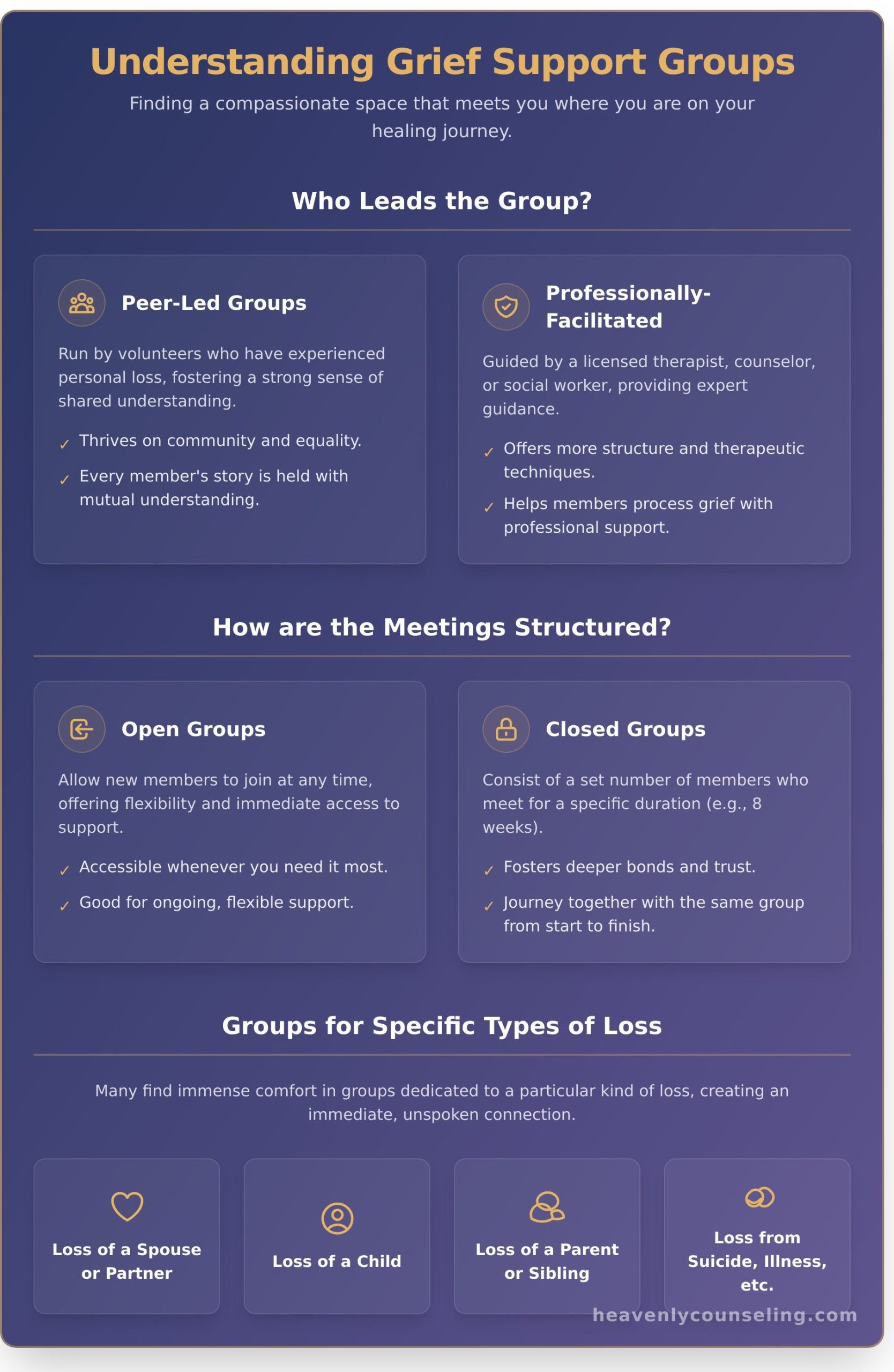
One of the biggest distinctions is who leads the group. Peer-led groups are often run by volunteers who have navigated their own personal loss.
These spaces thrive on a strong sense of shared community and equality, where every member’s story is held with mutual understanding. In contrast, professionally-facilitated groups are guided by a licensed therapist, counselor, or social worker.
These groups may offer more structure, incorporating therapeutic techniques and expert guidance to help members process their grief.
Open vs. Closed Groups: Which Is Right for You?
The format of a group can also shape your experience. Open groups allow new members to join at any time, offering flexibility and immediate access to support when you need it most.
Closed groups, on the other hand, consist of a set number of members who meet for a specific duration (e.g., eight weeks). While less flexible, this consistent structure can foster deeper bonds and a powerful sense of trust as you journey together with the same people from start to finish.
Groups for Specific Types of Loss
Many find immense comfort in a group dedicated to a particular kind of loss. This specificity creates an immediate, unspoken connection, as members share a unique and profound understanding of one another’s pain.
Finding a grief support group near me that focuses on your experience can feel like coming home. Common examples include groups for:
- The loss of a spouse or partner
- The loss of a child at any age
- The loss of a parent or sibling
- Grief from loss due to suicide, addiction, or a specific illness (like cancer)
Knowing these options exist can help you find a space where you feel truly seen and understood, allowing your healing to gently unfold.
How to Find a Grief Support Group Near You: Practical Steps & Resources
Taking the step to find support is a courageous and hopeful part of your healing journey. The right group can provide a safe, non-judgmental space to share your story and feel understood by others who know this path.
Your comfort and sense of safety are the most important factors, so it’s okay to take your time finding a community that feels right for you. Remember, this process is about what you need, at your own pace.
Online Directories and National Organizations
Your search can begin from the comfort of your home. Many trusted organizations offer searchable databases to help you find local meetings and connect with people who understand.
- GriefShare: A large, international network of faith-based groups that use a structured, video-based curriculum to guide discussions and support.
- The Compassionate Friends: Provides highly specialized support for families after a child, grandchild, or sibling has died.
- Psychology Today: Features a comprehensive directory that allows you to search for support groups in your area, many of which are led by mental health professionals.
- Meetup: While more informal, this platform can sometimes list peer-led grief support gatherings in your community.
Local Resources in Your Community
Sometimes, the most valuable connections are right in your neighborhood. When you’re looking for a grief support group near me, these local resources can offer compassionate guidance and direct referrals.
- Ask at local hospitals, hospices, or places of worship. Social workers and chaplains often facilitate or can refer you to established grief programs.
- Your doctor or a mental health professional can provide a personal recommendation based on your specific needs.
- Community centers and funeral homes frequently maintain lists of local bereavement resources as a service to the community.
Questions to Ask Before Joining a Group
Before you attend, it’s helpful to gather more information to ensure the group is a good fit. Feeling prepared can ease any anxiety. Don’t hesitate to reach out to the facilitator and ask a few questions:
- Is the group peer-led (by someone with lived experience) or professionally facilitated (by a counselor or therapist)?
- Is it an “open” group where new members can join anytime, or a “closed” group with a set number of sessions?
- Is there a cost to attend the meetings?
- What is the group’s general approach or philosophy on grieving?
- How many people typically attend each meeting?
Finding the right fit is a personal decision. If a group setting doesn’t feel right at this moment, remember that one-on-one counseling is another gentle path toward healing.
At Heavenly Counseling, we are here to walk alongside you, meeting you exactly where you are. It all begins with a conversation.
Beyond Groups: When to Consider Individual Grief Counseling
Sharing your story in a grief support group is a courageous and powerful step on your healing journey. The sense of community and shared understanding can be a profound source of comfort.
However, sometimes the weight of grief requires a more personalized, private space to unpack. Individual grief counseling offers just that-a dedicated, one-on-one partnership focused entirely on your unique experience.
It isn’t a replacement for group support but can be a vital companion to it, whether you engage with it first or alongside a group.
Signs You May Need One-on-One Support
While many people find what they need when they search for a grief support group near me, you might benefit from individual therapy if you recognize any of the following in yourself:
- Your grief feels all-consuming, making it difficult to manage daily tasks at home or work.
- You are experiencing symptoms of trauma, or your grief feels unusually prolonged and intense (sometimes called complicated grief).
- The idea of sharing your deepest feelings in a group setting feels overwhelming or unsafe right now.
- You have specific, complex emotions or circumstances surrounding your loss that you wish to explore in complete privacy.
How Individual Therapy Complements Group Support
Think of individual and group support not as an either/or choice, but as two hands working together to hold you up. In a private counseling session, a compassionate therapist can help you develop specific coping strategies for intense emotions like anger or guilt.
This safe space allows you to explore deeply personal aspects of your loss that you may not be ready to share with others, ultimately making you feel more prepared and confident when you do engage with your support group.
Combining Faith and Healing: Christian Grief Counseling
For many, faith is a guiding light in the darkest of times. If your relationship with God is a cornerstone of your life, Christian grief counseling can provide a unique layer of comfort and guidance.
This approach gently integrates biblical wisdom with proven therapeutic techniques, creating a space where your spiritual and emotional healing can happen in harmony. It offers a way to navigate loss while leaning on the promises of your faith. At Heavenly Counseling, we meet you where you are, with or without faith. Learn more.
Your Healing Journey Begins With a Single Step
Remember, the journey through grief is not one you have to walk alone. The strength found in shared stories can be a powerful source of comfort, and finding the right grief support group near me is a profound act of self-care.
It’s about discovering a safe space where you are understood. And sometimes, the path to healing is best supported by one-on-one guidance, honoring your unique pace and needs.
At Heavenly Counseling, our compassionate, professional counselors are here to walk alongside you. We meet you where you are, offering both faith-based and secular support to honor your personal journey.
Whether you are seeking in-person therapy in Flower Mound, TX, or online support throughout Texas and Florida, we are here to help.
It begins with a conversation. Schedule a free, 15-minute consultation.
Frequently Asked Questions About Grief Support Groups
What is the difference between grief counseling and a grief support group?
Grief counseling is a one-on-one therapeutic process with a licensed professional. It offers a private, structured space to explore the unique complexities of your loss, address trauma, and build personalized coping skills.
A grief support group, however, provides a community setting. It brings together people with shared experiences of loss to offer mutual comfort, validation, and encouragement in a peer-led or facilitator-guided environment. Both paths offer profound healing and can complement each other beautifully.
How much do grief support groups typically cost?
Many people find that cost is not a barrier to getting the help they need. A significant number of grief support groups are offered for free, especially those hosted by community hospices, hospitals, non-profits, or faith-based organizations.
Some groups may ask for a small fee, typically between $10 to $25 per session, to cover facilitator time or materials. When you search for a grief support group near me, you can often find a compassionate option that fits your budget.
Are online or virtual grief support groups as effective as in-person ones?
Both online and in-person groups can be deeply effective spaces for healing, and the best choice depends on what feels most comfortable for you. Virtual groups offer wonderful accessibility, allowing you to connect from the safety of your own home.
In-person meetings provide the unique comfort that comes from physical presence and shared space. The most important factor is finding a well-facilitated, compassionate group where you feel safe, seen, and understood on your journey.
How do I know if I’m ready to join a support group?
There is no perfect timeline for healing, and this decision is deeply personal. You might be ready if you feel isolated in your grief or have a strong desire to connect with others who truly understand what you are going through.
It is also completely okay if you don’t feel ready to share your story yet-many people attend simply to listen at first. Trust your heart. The right group will meet you where you are, without any pressure or expectations.
What happens if I start crying during a group meeting?
Crying is a natural and healthy part of the grieving process. A grief support group is one of the safest places to let your tears flow without fear of judgment.
You will be surrounded by compassionate people who understand the depth of your pain because they are on a similar journey. Your tears will be met with quiet understanding and gentle support, never discomfort. You are welcome to express your emotions exactly as they come.
How long should I attend a grief support group?
The length of time you attend is entirely up to you and what your heart needs for healing. Some groups are structured with a set number of sessions, such as an eight-week program, which can provide a clear path forward.
Others are ongoing, allowing you to attend for as long as it feels helpful. There is no right or wrong duration.
We encourage you to listen to your own needs and stay as long as the community feels like a source of comfort and guidance.