
That familiar fog rolls in again. You’re staring at a screen, reading the same sentence for the fifth time, but the words refuse to connect.
The frustration builds, and maybe a quiet worry begins to surface: “What’s wrong with me?” If you’re experiencing persistent difficulty concentrating, please know you are not alone in this feeling, nor are you broken.
This struggle is a deeply human experience, often a gentle signal from our minds and bodies that something needs attention.
This guide is here to offer compassionate understanding and a path forward. We will gently walk alongside you to explore the common, and often surprising, reasons for a scattered focus-from the weight of anxiety and unprocessed grief to simple lifestyle factors you might not have considered.
Together, we’ll uncover practical, gentle steps you can take to quiet the noise, reclaim your clarity, and find your way back to a more peaceful, focused state of mind. It’s time to begin your healing journey.
Understanding ‘Brain Fog’: You Are Not Alone in This Struggle
If you feel like you’re constantly wading through a mental haze, please know you are not alone. That frustrating sense of slowness, confusion, and forgetfulness is often called ‘brain fog.’
This experience of mental cloudiness, a key aspect in understanding ‘brain fog’, is not a personal failing. It is a shared human experience and a sign that your mind and body are asking for gentle attention.
Experiencing difficulty concentrating is a symptom, much like a headache or fatigue. It is a signal that something may be out of balance, not a character flaw you need to overcome through sheer willpower. Acknowledging this is the first compassionate step toward finding clarity.
What Does Difficulty Concentrating Feel Like?
This mental fog can show up in many small, often discouraging, ways throughout your day. You might recognize it as:
- Losing your place while reading a book or struggling to follow a conversation.
- Walking into a room and completely forgetting what you came to do.
- Feeling easily pulled away from a task by the smallest sounds or movements.
- A sense that even simple mental tasks, like writing an email, require a monumental effort.
Why It’s More Than Just ‘Having an Off Day’
Everyone gets distracted sometimes. However, when this pattern becomes persistent, it’s more than just an ‘off day.’
Chronic difficulty concentrating can begin to wear on your self-esteem, leaving you feeling unproductive or incapable at work, school, or home. It can quietly convince you that you are not trying hard enough, which simply isn’t true.
Instead of being hard on yourself, we invite you to approach this with gentle curiosity. Seeing this lack of focus as a signpost allows us to begin a healing journey to investigate the root causes-the first step toward finding your focus and peace once again.
Common Causes: A Look at Your Mind, Body, and Daily Life
If you find yourself struggling with a scattered mind, please know you are not alone. Our ability to concentrate isn’t a switch we can simply turn on; it’s a delicate balance influenced by our inner world, our physical health, and our daily surroundings.
Understanding these connections is the first gentle step toward finding clarity. Your difficulty concentrating is not a personal failing, but a signal that something in your life may need compassionate attention.
Let’s walk through some common areas that can affect our focus. As you read, see if anything resonates with your own experience, without judgment or pressure.
Emotional and Mental Well-being
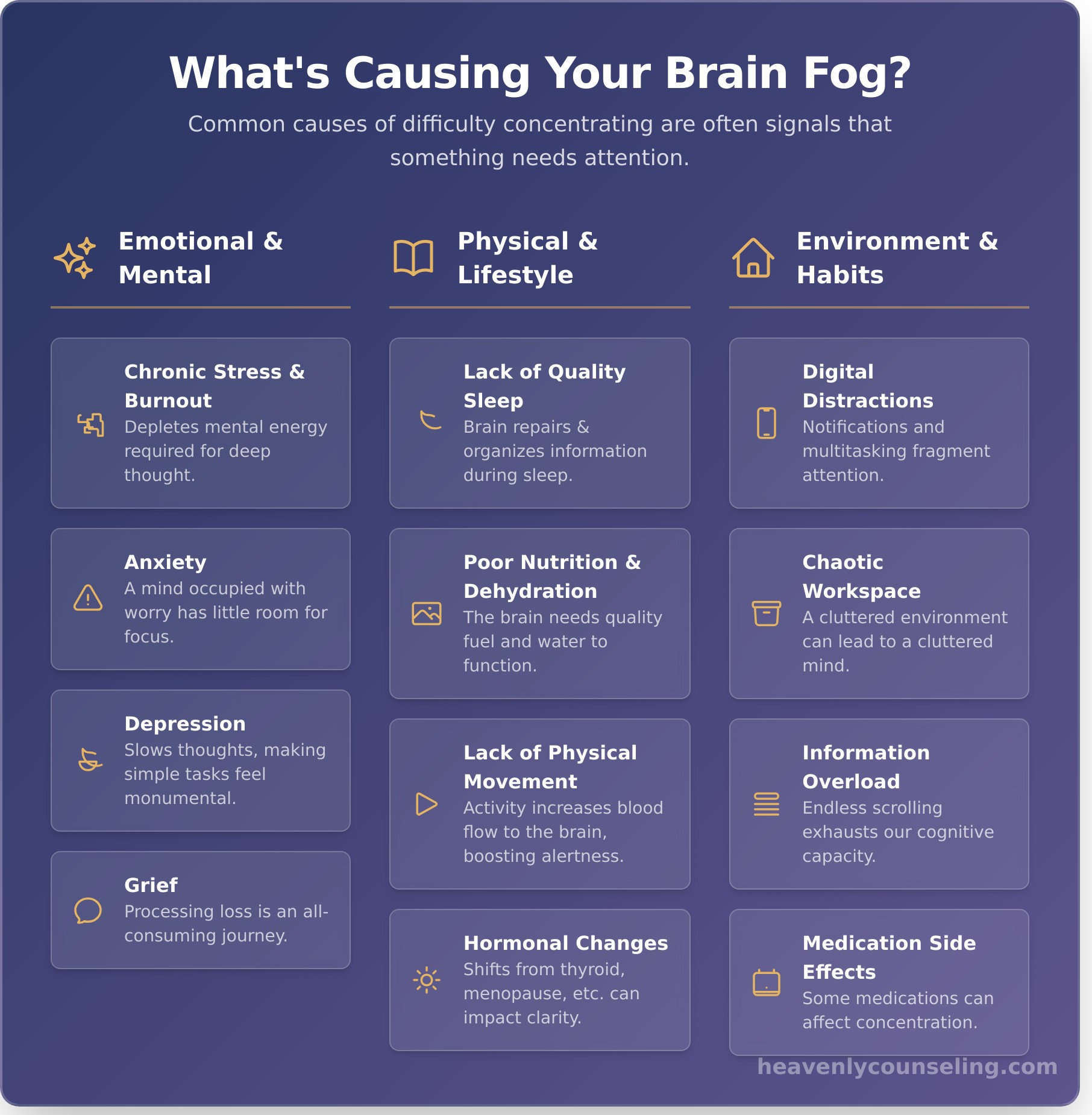
Our minds carry a heavy load, and when that load becomes too much, focus is often the first thing to suffer. Your emotional state is deeply and intricately tied to your cognitive function. Consider if any of these feel familiar:
- Chronic stress and burnout: Constantly running on empty depletes the mental energy required for deep thought, leaving you feeling drained and unfocused.
- Anxiety: When your mind is occupied with a loop of ‘what-if’ scenarios and worries, it has little room left for the present moment.
- Depression: This can feel like a heavy fog, slowing down your thoughts and making even simple tasks feel monumental.
- Grief: Processing a loss is an all-consuming journey that rightfully claims much of your mental and emotional energy.
Physical and Lifestyle Factors
Your mind and body are in constant conversation. When your body is not properly rested or nourished, your brain cannot perform at its best. Many of these physical issues are among the Common Causes of Brain Fog, a feeling closely linked to difficulty concentrating.
- Lack of quality sleep: Sleep is when your brain rests, repairs, and organizes information. Without it, clarity is nearly impossible.
- Nutritional gaps and dehydration: Your brain is a high-energy organ that needs consistent, quality fuel and water to function effectively.
- Lack of physical movement: Gentle activity increases healthy blood flow to the brain, which can boost alertness and cognitive function.
- Hormonal changes: Shifts related to thyroid issues, menopause, or other conditions can significantly impact mental clarity.
Your Environment and Habits
Sometimes, the biggest barriers to focus are hiding in plain sight. Our modern world is filled with distractions that constantly pull for our attention, making sustained focus a real challenge.
- Digital distractions: The endless pings, notifications, and temptation to multitask can fragment our attention into tiny, ineffective pieces.
- A chaotic workspace: For many, a cluttered physical environment can contribute to a cluttered and overwhelmed mind.
- Information overload: Endless scrolling through news and social media can exhaust our cognitive capacity, leaving little left for other tasks.
- Medication side effects: It’s important to remember that some medications can affect concentration. If you have concerns, it is always best to have a conversation with your doctor.
The Anxiety-Focus Connection: Why Worry Steals Your Attention
If you constantly find your thoughts scattering just when you need them most, it’s not a sign of weakness or a lack of willpower. One of the most common, yet often overlooked, reasons for having difficulty concentrating is anxiety.
Think of anxiety as a sensitive smoke alarm that’s stuck in the “on” position. The constant, blaring noise of worry and fear makes it nearly impossible to hear, let alone focus on, the quiet and important tasks in front of you.
This persistent state of alert can quietly hijack your attention, leaving you feeling frustrated and drained.
Your Brain on High Alert
When you are anxious, your brain shifts into survival mode, constantly scanning your inner and outer worlds for potential threats. This protective instinct is powerful, and it diverts precious mental energy away from your prefrontal cortex-the part of your brain responsible for complex thought, planning, and focus.
This is the very heart of The Anxiety-Focus Connection; your mind, in an effort to keep you safe, automatically prioritizes perceived dangers over the report on your desk or the conversation with a loved one. It becomes physically difficult to concentrate on these non-urgent things when your system is primed for a crisis.
The Weight of Cognitive Overload
Anxious thoughts also create a relentless stream of mental background noise. This internal chatter-the “what-ifs,” the worst-case scenarios, the replaying of past events-fills up your brain’s “working memory,” which is the temporary space you use to manage information.
It’s like trying to run dozens of programs on a computer at once. Eventually, the system slows down, freezes, and struggles to process anything new.
This cognitive overload is a profound source of the difficulty concentrating that so many people experience, making it hard to learn, remember, or follow through on tasks.
Feeling overwhelmed by worry? Let’s talk about it.
Grief and Concentration: How Healing Consumes Mental Energy
If you’re walking through a season of loss, you may have noticed a persistent brain fog that makes even simple tasks feel monumental. This isn’t a sign of weakness; it’s a profound and normal response to grief.
Grieving is not a passive state of sadness-it is one of the most demanding jobs your heart and mind will ever undertake, consuming vast amounts of mental and emotional energy.
Why Grief is Mentally Exhausting
Grief fundamentally changes your world, and your brain has to work incredibly hard to process that change. It’s like re-learning how to navigate life without a person, a role, or a future you once knew.
Every moment can be filled with a quiet, internal battle as memories of the past, the pain of the present, and anxieties about the future all compete for your attention. This deep emotional work leads to profound mental fatigue, which is why difficulty concentrating is one of the most common experiences during bereavement.
Forgetfulness, distraction, and a feeling of being mentally “stuck” are simply signs that your mind is dedicating its resources to the essential work of healing.
Giving Yourself Grace During a Time of Loss
During this tender time, the kindest thing you can do is release the pressure to be productive. Your energy is being used for healing, and that is more than enough.
Patience with yourself is not an indulgence; it is a crucial part of the process. Try to reduce your mental load where you can:
- Simplify your to-do list: Focus only on what is absolutely essential for today.
- Postpone major decisions: If a choice can wait, give yourself time and space.
- Accept help: Allow others to support you with meals, errands, or chores.
Please know that your focus will gradually return. As your heart heals, your mind will find its clarity again. It’s a journey that unfolds one day at a time, at your own pace.
If the weight of grief makes it hard to move forward, you don’t have to carry it alone. Our compassionate grief counseling provides a safe space to process your loss without judgment. It begins with a simple conversation, where we meet you right where you are.
Gentle, Practical Steps to Help Reclaim Your Focus
Understanding the roots of your distraction is a compassionate first step. Now, we can gently turn toward what helps.
Think of the following ideas not as strict rules, but as quiet experiments. The goal is not to force your mind to pay attention, but to create a safe, calm space where your focus can naturally return.
Mindfulness and Grounding Techniques
When your mind feels scattered, bringing your attention back to the present moment can be a powerful anchor. These gentle practices are designed to quiet the inner noise without pressure.
- Practice single-tasking. Instead of juggling multiple tabs and to-do lists, give your full, gentle attention to just one thing at a time.
- Try a 5-minute breathing exercise. Simply close your eyes, place a hand on your belly, and notice your breath moving in and out. This can calm your nervous system in minutes.
- Use the 5-4-3-2-1 method. When you feel overwhelmed, ground yourself in your senses. Acknowledge 5 things you can see, 4 you can feel, 3 you can hear, 2 you can smell, and 1 you can taste.
- Schedule ‘worry time.’ Set aside a specific 10-15 minute period to acknowledge your worries. This helps contain them so they don’t spill into your entire day.
Creating a Focus-Friendly Environment
Your surroundings have a quiet but significant impact on your state of mind. Small adjustments can create a more peaceful and productive atmosphere, reducing the external triggers that contribute to difficulty concentrating.
- Silence notifications. For a set period, turn off phone and computer pop-ups. This creates an uninterrupted space for your thoughts to settle.
- Declutter your immediate workspace. A tidy desk can lead to a calmer, more ordered mind. Take two minutes to clear what’s in front of you.
- Use ‘time blocking.’ Dedicate specific blocks of time in your calendar to a single task. This signals to your brain that it’s time to focus on one priority.
- Incorporate short breaks. Stand up, stretch, or walk to the window every hour. A brief moment of movement can refresh your mind.
Nourishing Your Brain and Body
Your mental clarity is deeply connected to your physical well-being. Supporting your body is a foundational act of kindness to your mind.
- Prioritize a consistent sleep schedule. Aiming for 7-9 hours of sleep helps your brain reset and repair.
- Stay hydrated. Dehydration is a common and often-overlooked cause of brain fog. Keep a glass of water nearby.
- Choose brain-healthy foods. Small snacks like a handful of walnuts, almonds, or berries are known to support cognitive function.
- Take a short walk outside. Even five minutes of fresh air and sunlight can improve your mood and mental clarity.
Remember to be patient and compassionate with yourself as you explore what works. If your difficulty concentrating feels persistent and overwhelming, please know you are not alone. Sometimes, the most helpful step forward begins with a conversation.
When to Seek Support: How Counseling Helps Clear the Fog
Taking steps to reclaim your focus is a courageous act of self-care. The strategies in this guide can build a strong foundation for mental clarity.
But sometimes, even with our best efforts, the fog doesn’t lift. It’s important to remember that you don’t have to navigate this journey alone.
While self-help is valuable, there are times when the most compassionate step we can take is to ask for a guide to walk alongside us.
Persistent difficulty concentrating can be more than just a bad day or a busy week; it can be a gentle signal from your mind and body that a deeper issue needs attention. Viewing therapy not as a last resort, but as a supportive space to find clarity, can be a powerful shift in perspective. It’s a dedicated time for you to be heard, understood, and guided back to yourself.
Signs It’s Time to Talk to a Professional
If you recognize yourself in any of the following, it may be a sign that speaking with a counselor could bring you relief:
- Your lack of focus is causing you significant emotional distress or frustration.
- It is negatively impacting your performance at work or school, or causing tension in your relationships.
- You have a feeling it might be connected to ongoing anxiety, lingering depression, or unprocessed grief.
- The self-help strategies you’ve tried have been helpful, but they just don’t feel like enough.
How a Counselor Can Help Your Journey
A compassionate counselor meets you exactly where you are, offering a safe, non-judgmental space to explore the roots of your difficulty concentrating. In this partnership, a professional can:
- Help you gently uncover the root causes of your brain fog-whether it’s stress, anxiety, or life transitions.
- Teach you personalized coping strategies to manage overwhelming thoughts and feelings.
- Provide a safe space to process difficult experiences like grief and loss, which often impact focus.
- Guide you in building sustainable habits that support long-term mental clarity and emotional peace.
You deserve to feel present and engaged in your own life. If you feel stuck, please know that seeking support is a sign of incredible strength.
It all begins with a simple, gentle conversation. If you’re ready to explore what that could look like, we warmly invite you to learn more at heavenlycounseling.com.
Your Path Back to Clarity
Feeling scattered isn’t a personal failure; it’s a sign that your mind and body are carrying a heavy load. As we’ve explored, factors like underlying anxiety, the quiet weight of grief, and even daily stress can deeply impact your ability to focus.
Recognizing that you are not alone in this struggle is the first, most compassionate step toward reclaiming your mental space.
While the gentle strategies in this guide can help, persistent difficulty concentrating is often a signal that you deserve dedicated support. At Heavenly Counseling, our compassionate, professional counselors specialize in helping people find their way through anxiety and grief.
For residents of Texas and Florida, our online therapy provides a safe, accessible space to begin your healing journey. You don’t have to clear the fog on your own.
It begins with a conversation. Schedule a free, 15-minute consultation today. Taking this gentle first step is a powerful way to honor your need for peace and focus.
Frequently Asked Questions About Concentration
Can my diet or certain foods really affect my ability to concentrate?
Yes, what you eat has a gentle but direct impact on your mind. Foods high in sugar can cause energy spikes and subsequent crashes, making steady focus a challenge.
On the other hand, brain-nourishing foods like nuts, blueberries, and fatty fish provide stable energy. Staying hydrated with plenty of water is also a simple, powerful way to help clear brain fog and improve your ability to concentrate throughout the day.
How can I tell if my concentration issues are from anxiety or ADHD?
It can feel confusing, as both can create a restless mind. Often, anxiety-related focus issues stem from worry-your thoughts are preoccupied with “what ifs.”
With ADHD, the difficulty concentrating is typically more persistent across all situations, not just stressful ones, and may be accompanied by restlessness or impulsivity. The kindest step you can take is to speak with a professional who can walk alongside you to find clarity and a path forward.
Can technology and social media addiction cause long-term focus problems?
This is a very common concern in our modern world. The constant notifications and rapid content shifts from technology can train our brains to expect and crave constant stimulation.
Over time, this can make it harder to settle into deep, sustained focus on a single task. Creating gentle boundaries, like having screen-free time or turning off notifications, can help your mind relearn the peaceful art of staying present and focused.
How long does it typically take to see an improvement in focus with therapy?
Your healing journey is uniquely yours, so there is no specific timeline. Some people feel a gentle shift within a few weeks as they learn new coping skills, while for others, lasting improvement may take a few months of exploring the root causes.
The most important thing is to be patient with yourself. We believe progress happens at your pace, and every small step toward feeling more grounded is a meaningful one.
What is one simple mindfulness exercise I can do at my desk to refocus?
Try the “5-4-3-2-1” grounding exercise. When you feel scattered, gently pause and notice five things you can see, four things you can physically feel (like your feet on the floor), three things you can hear, two things you can smell, and one thing you can taste.
This simple practice brings your awareness back to the present moment, quieting the noise and helping you return to your task with a sense of calm.
Could a medication I’m taking be the cause of my brain fog?
It is possible, as certain medications can list brain fog or difficulty concentrating as a side effect. If you have concerns that a new or existing prescription is impacting your focus, the safest first step is to have a conversation with your prescribing doctor.
They can help you understand what’s happening and explore your options without you having to make any changes on your own. Your well-being is what matters most.
Is it normal for concentration to get worse during stressful periods?
Yes, it is absolutely normal and very human. When you experience stress, your brain redirects its energy toward managing the perceived threat, leaving fewer resources for complex tasks like deep concentration.
Please be gentle with yourself during these times. Acknowledging that your focus is being impacted by stress is a compassionate first step. As the stress lessens, your clarity will often return naturally.